OKMO 916: The Story Behind a Desktop-Scale Single-Cylinder Four-Stroke with Old-School Deutz Character
When serious engine-history sources mention “Deutz 916,” they are not referring to a modern automotive or truck engine.
The name points back to a much older piece of industrial machinery: the Deutz MAH 916, a horizontal,
single-cylinder, four-stroke diesel engine with roughly a 120 × 160 mm bore and stroke, approximately
1.81 liters of displacement, and an output in the neighborhood of 16–18 PS at around 1,300–1,500 rpm,
depending on version and reference.
These engines belonged to the world of stationary power, agricultural machinery, pumps, generators, and workshop equipment—
a world defined by cast iron, heavy flywheels, mechanical simplicity, and machines designed to run for decades.
The OKMO 916 is not a literal 1:X scale gasoline reproduction of the MAH 916.
If it were, it would end up as an unusually long horizontal engine that would make little sense as a practical desktop model.
Instead, the OKMO 916 takes a more familiar approach in the model-engine world: it borrows the
mechanical vocabulary and subsystem philosophy of early Deutz single-cylinder stationary engines,
particularly machines in the MAH 914/916 family, and adapts those ideas to the practical constraints of a small working model.
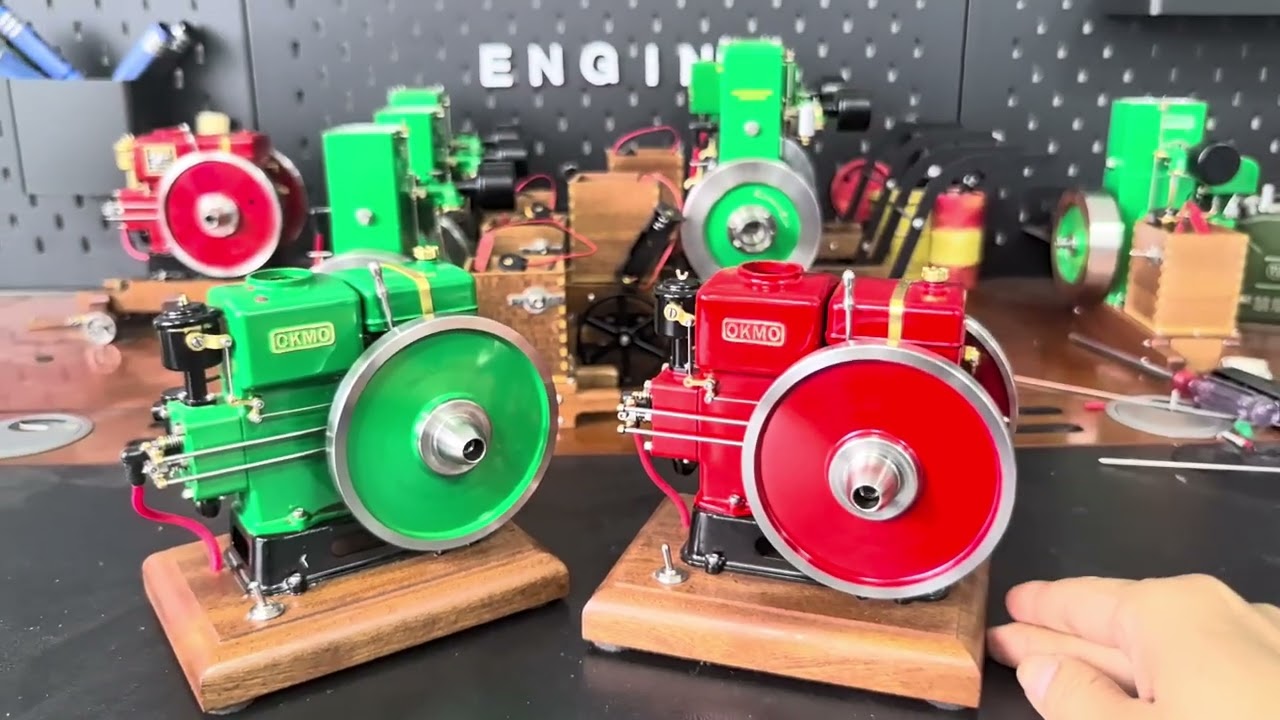
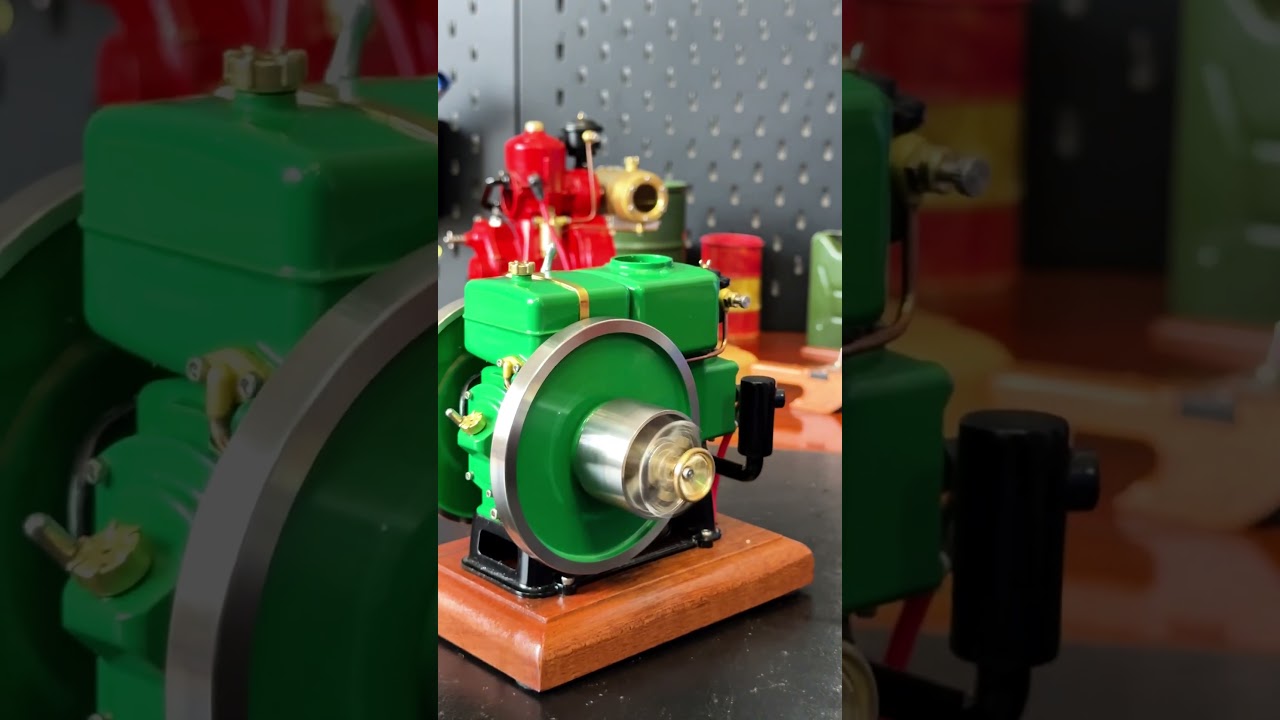
The result is a compact, vertical, water-cooled, four-stroke gasoline engine designed to run on a desktop
while retaining much of the character of old industrial machinery.
1) What Does “916” Refer To? The Historical Context
1.1 From Otto's Four-Stroke Engine to the Industrial Flywheel Aesthetic
The roots of Deutz stretch back to 1864, when N. A. Otto & Cie was founded in Cologne.
The company is widely associated with the beginnings of commercial internal-combustion-engine manufacturing.
In 1876, Nikolaus August Otto developed the experimental four-stroke engine that would become one of the defining
milestones in internal-combustion history. Early engines of this period were typically gas-fueled, slow-running machines whose
design principles later spread throughout industrial engine production.
That engineering lineage eventually produced several visual and mechanical traits that enthusiasts immediately associate with classic stationary engines:
-
Large, heavy flywheels, using rotational inertia to smooth the long intervals between power strokes in a single-cylinder engine.
-
Cast-iron construction and replaceable or machinable cylinder surfaces, emphasizing durability and serviceability.
-
Proper lubrication and cooling systems, even on relatively simple stationary engines.
-
Mechanical speed and load control, important when an engine was driving equipment such as pumps, generators, mills, or threshing machinery through belts.
This combination of exposed mechanics, functional simplicity, and heavy industrial construction created an aesthetic that remains highly recognizable today.
1.2 The MAH 916: The Historical Engine Behind the Number
Among vintage Deutz stationary engines, the MAH 916 is one of the models that can be clearly identified in surviving documentation and enthusiast records.
Typical specifications include:
-
Bore × Stroke: 120 × 160 mm
-
Displacement: approximately 1.81 L
-
Output: around 16 PS at approximately 1,300 rpm, with other ratings appearing depending on version
-
Configuration: horizontal single-cylinder
-
Cycle: four-stroke
-
Fuel: diesel
-
Ignition: compression ignition
-
Cooling: liquid cooling, with older stationary-engine practice also making extensive use of simple evaporative-style cooling arrangements
Visually, engines of this family are immediately recognizable for their
large flywheels, substantial crankcase and side covers, exposed fasteners, elevated tanks or cooling reservoirs,
and unmistakably heavy industrial appearance.
For that reason, the “916” designation on the OKMO model can reasonably be read as a
stylistic nod to the Deutz single-cylinder stationary-engine era, rather than a claim that the model is a dimensionally accurate scale reproduction of an MAH 916.
2) Original Inspiration vs. OKMO 916: How Similar Are They Really?
| Category |
Vintage Deutz-Era Single-Cylinder Engine |
OKMO 916 Desktop Model |
What Carries Over |
| Operating Cycle |
Four-stroke |
Four-stroke |
✅ Same fundamental thermodynamic cycle |
| Cylinder Layout |
Horizontal |
Vertical |
❌ Changed for desktop packaging, machining, and maintenance |
| Fuel / Ignition |
Diesel / compression ignition |
95+ octane gasoline / CDI spark ignition |
❌ Gasoline and spark ignition are far more practical at this miniature displacement |
| Cooling |
Liquid / evaporative-style cooling depending on design |
Water-cooled with reservoir |
✅ Retains a functional cooling system rather than relying solely on air cooling |
| Lubrication |
Splash and/or pumped lubrication depending on version, with service points for oil |
Independent lubrication system using a piston pump, internal oil passages, dipstick, and drain plug |
✅ One of the strongest links to full-size industrial-engine thinking |
| Speed / Load Control |
Mechanical governor acting on the fuel system |
Adjustable carburetor and throttle linkage; CDI handles ignition triggering |
⚠️ Similar goal, but achieved with a more modern miniature-engine arrangement |
| Materials & Wear Surfaces |
Cast iron, steel shafts, machined bearing and cylinder surfaces |
Brass + aluminum alloy + wood, with a honed cast-iron cylinder liner and metal piston rings |
✅ The liner-and-ring approach brings genuine engine-style wear surfaces into the model |
So how close is it?
Visually, the OKMO 916 is best described as an interpretation of the character and mechanical language of vintage stationary engines,
rather than a scale replica.
Where the resemblance becomes more meaningful is in the engineering philosophy.
The model retains features such as dedicated water cooling, an independent lubrication circuit, an oil dipstick, an oil drain point,
a serviceable cylinder-liner concept, substantial flywheels, and accessible mechanical adjustments.
In other words, it does not simply copy the silhouette of an old engine.
It attempts to bring some of the engineering discipline of a full-size stationary engine down to desktop scale.
3) The Details Model-Engine Enthusiasts Will Actually Want to Talk About
3.6cc Done Properly: 16 mm Bore × 19 mm Stroke
A displacement of just 3.6cc might sound tiny, but displacement alone does not determine whether an engine feels like a serious mechanical model.
What matters is how the working surfaces are built.
The OKMO 916 uses a precision-honed cast-iron cylinder liner with metal piston rings.
That is an important detail for anyone familiar with working miniature engines.
Rather than relying only on a coated or simplified cylinder surface, the combination of a honed iron liner and conventional metal rings
gives the engine a much more traditional internal-combustion architecture.
It is exactly the kind of detail that makes a miniature engine feel less like a moving display piece and more like a genuinely serviceable machine.
A Real Lubrication System: Piston Oil Pump → Internal Oil Passages → Crankshaft and Connecting Rod
One of the most interesting features of the OKMO 916 is that lubrication is not treated as an afterthought.
Dedicated oil passages are incorporated into the crankshaft and connecting rod,
with lubricant supplied by a piston-type oil pump.
Oil is added through the dipstick opening at the rear of the engine, using
5W-40 or four-stroke engine oil, and used lubricant can later be drained through the
rear oil-drain plug.
That maintenance routine feels much closer to servicing an actual engine than simply adding a few drops of oil to exposed bearings before a run.
For mechanically minded collectors, this may be one of the most interesting parts of the entire model.
Water Cooling That Actually Has a Job
The cooling system is functional rather than purely decorative.
The engine uses a water-cooling arrangement with a reservoir, and cooling water must be added before operation
and drained afterward for storage.
For a working single-cylinder four-stroke model, that gives the engine considerably more mechanical character than simply machining
cooling fins into the cylinder and calling it finished.
A Complete Ignition and Starting System
The starting and ignition system includes:
- CDI pulse ignition
- 3/16-40 threaded spark plug
- 1 × 1.5V AA battery
- Manual starting
- Electric-drill starting rod
- Adjustable carburetor
- Throttle linkage
The carburetor needle is preset from the factory but can still be fine-tuned for different operating conditions or fuel characteristics.
That adjustability matters because tuning is part of the appeal of a real running model engine.
You are not simply pressing a button and watching an animation—you are operating a miniature internal-combustion engine.
Twin Stainless-Steel Flywheels: Part Visual Drama, Part Physics
A single-cylinder four-stroke produces only one power stroke every two crankshaft revolutions.
That makes flywheel inertia especially important.
The OKMO 916 uses twin stainless-steel flywheels, adding rotational inertia to help carry the crankshaft through the non-power strokes
and allowing the engine to maintain a slower, steadier idle.
And, of course, there is another reason enthusiasts love big flywheels:
Few things look better on a desktop engine than a pair of polished wheels turning slowly while the valve gear and crank mechanism work away beside them.
That is old-school stationary-engine charm in miniature.