

When learning about engines, many beginners’ first instinct is to assume that engines capable of high RPM deliver better performance. They subconsciously believe that higher specifications are more likely to result in better performance.
However, when it comes to model engines, achieving smooth operation at low RPM is actually the more challenging feat.
So why is that? The following content will explain this, helping you better understand the two optimization approaches for high and low RPM, as well as the characteristics of model engine products.
High vs. Low RPM
In full-size engines, RPM represents the number of revolutions the engine crankshaft makes per minute.
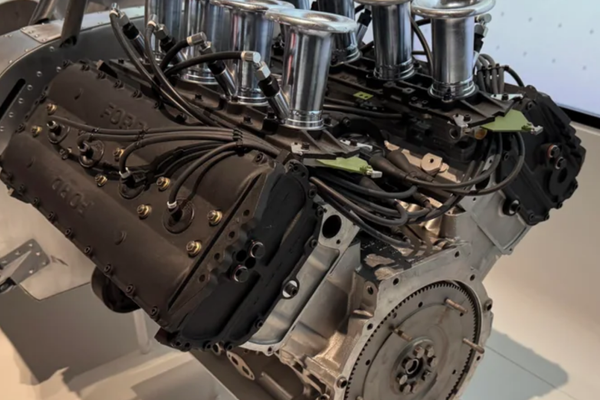
Correspondingly, high-performance engines can typically reach RPM ranges of 6,000–12,000+ RPM, or even higher; while the low-RPM range for engines is typically between 800 and 3,000 RPM.
Engines capable of high RPM generally deliver stronger bursts of power, faster response, and higher power density; conversely, low-RPM engines operate more smoothly, are more fuel-efficient, and offer greater durability. This illustrates that high RPM often emphasizes “power delivery,” while low RPM emphasizes “stability and precision.”
High and low RPMs represent two distinct approaches to engine design optimization. System designs for high RPMs are intended to test whether the engine can withstand high-frequency cycles and sustain continuous output, while system designs for low RPMs are intended to test whether the engine can maintain minimal energy cycles and prevent stalling.
Therefore, high and low RPMs do not inherently indicate superior or inferior performance; rather, it is more important to assess whether the engine can maintain a stable, controllable, and consistent operating state within its respective RPM range.
Why Is Achieving Low RPM a Greater Challenge for Model Engines
In the field of model engines, low-RPM operation is often more difficult to achieve.
As mentioned earlier, the design objective for low RPM is to ensure the engine runs smoothly at lower energy cycles without stalling. At low RPM, the engine no longer relies on high-speed inertia to maintain the cycle but instead depends entirely on the continuity of each combustion cycle to keep running.
Consequently, low RPM places higher demands on inertia control and system precision.
For model engine products, their inherently small size and lightweight components result in lower inertia, making stable control more difficult. Furthermore, their compact dimensions amplify the sensitivity of the ignition and intake systems to even minor errors.
As a result, compared to standard full-size engines, model engines face greater technical challenges in balancing component inertia, controlling the air-fuel ratio, and managing ignition timing. Stable operation at low RPMs places higher demands on the quality and precision of model engine components.
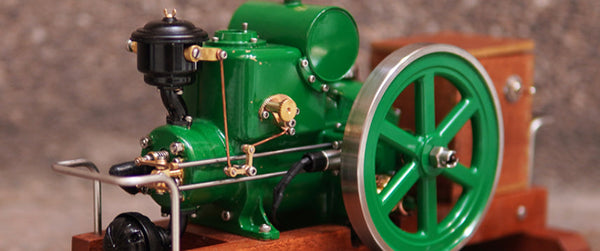
Among operational model engines, OS engines offer the best low-RPM control, capable of reaching as low as 800 RPM. As a result, these engines are frequently chosen by enthusiasts for more challenging modification projects.
RPM Performance of Our Newly Upgraded F2 Twin-Cylinder Engine
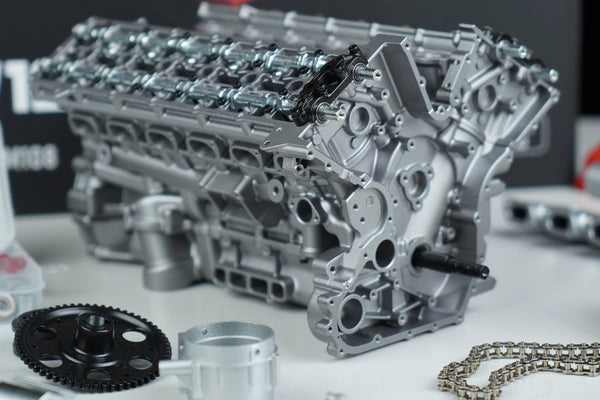
Our latest upgraded version of the VAMRION F2 features multiple design improvements over the previous FSL200 twin-cylinder model. This VAMRION F2 Engine Model achieves stable operation at lower RPMs and is less prone to stalling.
The newly upgraded F2 model engine is equipped with a high-precision carburetor that responds quickly, allowing for better control of the air-fuel ratio.
Compared to the previous version, it is easier to start, with smoother startup and operation, significantly lowering the barrier to entry for beginners and making it more user-friendly for newcomers.
Performance upgrades also make this product more suitable for a wider range of modification projects of varying difficulty, opening up more possibilities for DIY customization.
The new VAMRION F2 engine kit is scheduled to ship around June 10. The first 200 pre-order units are specially designed collector’s editions and come with exclusive bonus items.
If you’re interested in engine model kits like this, we invite you to purchase this newly upgraded model and experience the authentic thrill of starting an engine.
0 comments